
Weaving Words, Together
Why Creative Community Matters More Than Polished Perfection

For years I was part of a weekly knitting night, where between two and twelve women would go for dinner, drink wine, and then someone else would help me pull apart the mistakes I’d made thanks to the booze. True solidarity. One of them in particular always had more faith in my skill than I ever did -- I still struggle to count stitches and I’ve been knitting for forty-five years, on and off-- and urged me to try more technically difficult projects, but for me it was never about the end result. It was all about the company. A close-knit group, if you will. (I’m sorry, I tried to stop myself.)
Various realities pulled that group apart over the years: city moves, international moves, the early years with kids. But I still cherish the times spent around the big square tables of Ray’s Jazz in the old Foyles, and in Leon up by Liberty. It was women in conversation, from disparate backgrounds, bound together by wool, silk, cotton, bamboo, even qiviut. Certainly loud, and occasionally bawdy conversation, many separate strands at once yet still in harmony. Our version of waulking.
Writing in community has a similar colour for me. We’re all working on something idiosyncratic, as different as socks for our mums versus clones of high-end knitwear. I was always the one knitting something gently useful, like bed socks. I still knit a lot of socks, usually all from the same basic vanilla top down pattern. I spent so many years trying to write in the same way, to a specific pattern, to the point where I got myself so stuck I stopped writing at all and then I stopped reading too. Bleak, mean times.
Many of the women I know, and most of the women I work with are mending their relationships with their own trust, creativity and writing practice, but it’s often something that’s fraught with shame. Especially mothers, who often leave their own creative pursuits aside while nourishing play and experimentation in their children’s lives. Maybe they never believed they could write, or stopped believing it. Stopped painting or didn’t open the new sketchbook. Saw needle and thread only as tools for repairing hems and sewing on Beavers badges, though that could be a really particular and specific bugbear of mine.
The tipping point for me was when I realised I’d hidden away from weaving narrative. Story threads got too confused in my menopausal, fibro-fogged mind — and even that took me some time to untangle. When I was ready to change, I set up a Substack newsletter, with a publication name — Whizzy Brain — that defined how I was feeling. A couple of years later, I even started writing it.
I am relearning how to wear my skin with my mistakes and history on the outside rather than hiding them away. We are all embroidered with the scars of past experiences. It’s impossible to go back to box-fresh, blank canvas status.
That’s probably why I went from carefully darning my lovely soft cashmere cardigan in hidden colours, to needle felting it with pops of bright roving.
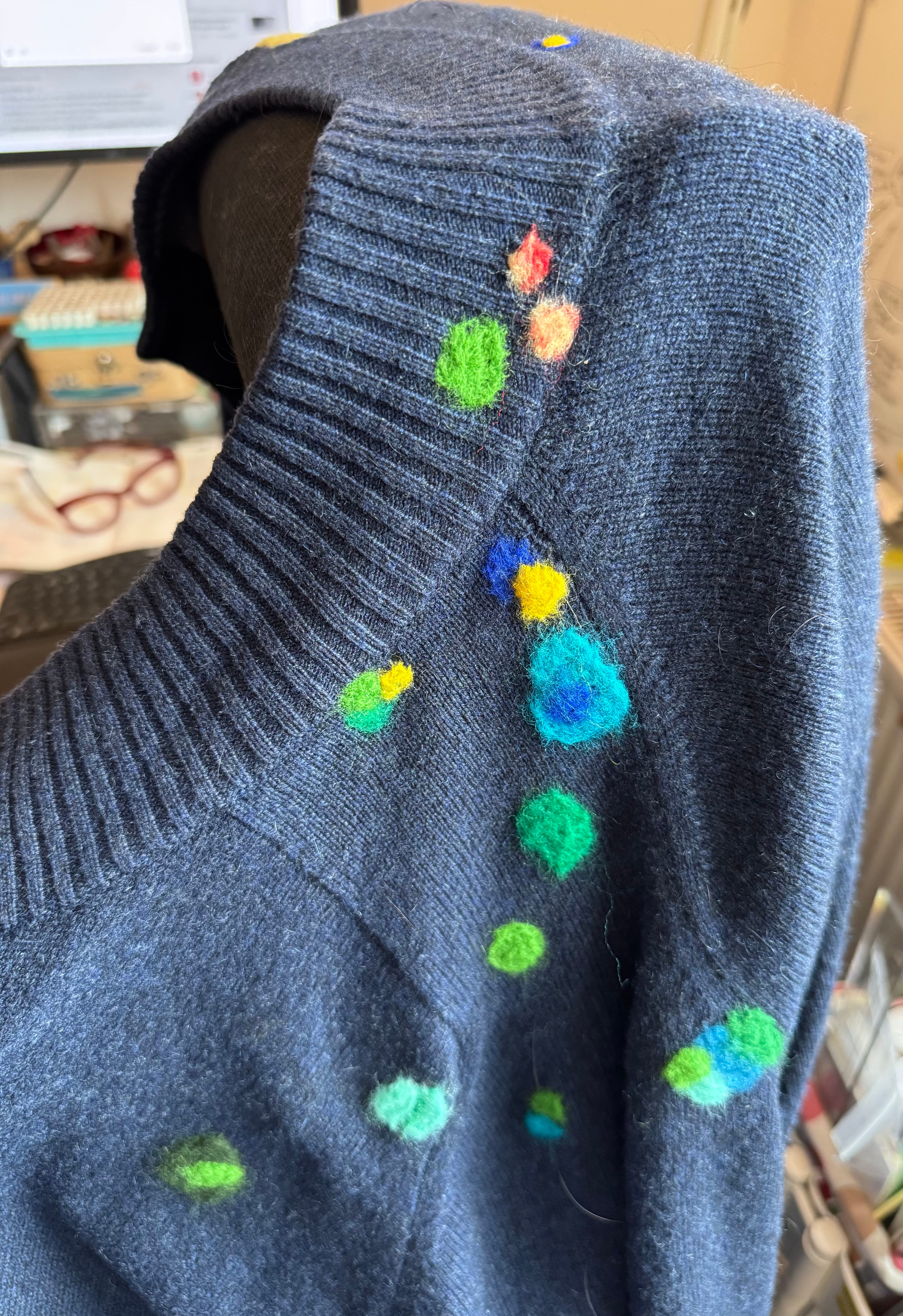
We don’t have to be perfect reproductions of our original selves. Now I have a unique garment that still serves its purpose. Plus I enjoyed the stabbing.
I’ve mended in company a couple of times. When I was recovering from surgery, a dear friend bought me a really thoughtful gift: a workshop in visible darning which we took together, and we convened a few times over video to practice our new skills. I mostly learned that I wasn’t great at it, but appreciated the practice.
Writing in company is something I’m much more familiar with, that brings me a lot of joy. I watch, week on week, as women repair their connections, in community - there’s a great comfort in seeing the same faces pop up each week, even if you don’t have any other connection. A ritual act that’s soothing to a neurodivergent mind.
I wonder whether body doubling — something that a lot of us neurodivergents use as a tool to get anything done — is just a form of being in community. I think it’s also a throwback to times when we lived more on top of one another, in different family and societal structures: like when women waulked. I wish more of us were extolling the virtues of it louder!
For me, it’s worth investing my time into something cherished to repair it. It demonstrates to anyone who cares to look closely enough that I value it, often even more after the mend is finished. The act of mending is as valuable, sometimes more so, than the end result. My writing practice is the same.
Doing that in company makes it more joyful, and elevates an activity that could become routine into a community practice, and it’s also a way of keeping these skills alive, and our minds whirling in a positive way.
That’s why I mend, and that’s why I write together with other women. The act of participating is as valuable, and joyful, as anything I could produce from it.
Thanks to 💖 Claire Venus ✨ , Lauren Barber, Laura Durban, Georgia, Laurita Gorman & Lyndsay Kaldor for the invitation to think about Waulking as part of IWD 26!